
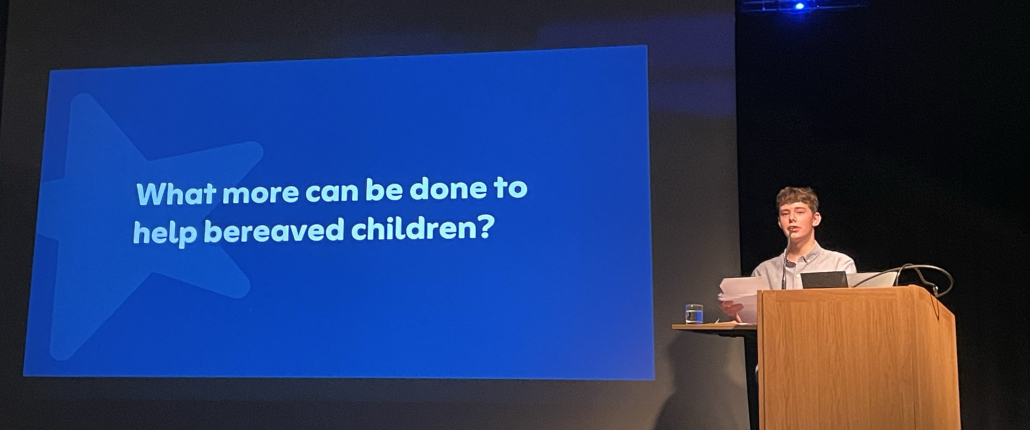
Henry’s story: What more can be done to help bereaved children?
We were delighted when 15 year old GCSE student and SeeSaw beneficiary, Henry, shared with us the incredible speech he wrote and presented for an English assessment at school. Receiving a distinction for his work, Henry explored the question: “What more can be done to help bereaved children?” whilst bravely sharing his own experience of bereavement after his sister, Grace, died at the age of 5 when he was 8 years old.
Highlighting the need for greater funding for children’s bereavement services like SeeSaw, in his speech Henry advocated for bereaved children and young people not only in his local community, but on a national scale.
Henry’s Story
“Some would say that butter would melt in the mouth” is the one line I remember from my sister’s funeral. Grace was 5 when she passed away. At the time, I was lucky enough to receive support that helped me through it initially, but also later on in primary school when I found myself needing help again. However, many other children do not receive the support that they need following a bereavement. I stand here today speaking not only from research but from life experience, and also the conversations I’ve had with professionals who help people on a day-to-day basis. I stand before you today to ask the question, “Is enough really being done to help those in their most vulnerable times?”
SeeSaw is a charity based in Headington that provides support for children and young people across Oxfordshire following a bereavement. In the last year, they helped over 450 young people across 345 families. And in their 25 years of working in Oxfordshire, they have helped more than 8000 young people. They not only work with the young people themselves, but also with schools and parents to help them help the young people. They were kind enough to give up some of their time to speak with me and help me understand the massive impact they have.
Whilst it may not be obvious, around one child in every classroom will be bereaved before the age of 16. Many people feel alone in their bereavement, but often others around you have gone through the same thing as you. A lot of the time, people hide their grief, perhaps out of shame or maybe just wanting to seem tough and following the saying, “boys don’t cry”. And that is not just a saying, it is a reality. SeeSaw sees a huge decline in the amount of engagement with support when boys turn 15. However, we don’t know the reason why there is such a drop-off.
Now you may be asking yourself, Why do we know so little about childhood bereavement? Put simply, it is from a lack of research. We do not know how many children are bereaved every year. We can make estimates from the number of adults who pass away every year, but even that is an imperfect estimate, as there is no national collection of statistics for how many children lose a parent, a carer or a sibling. But we currently cannot truly understand the scale of bereavement in the UK in children. How can you plan support for all the young people when you have no idea how many to expect?
And yet, despite affecting so many young people, how much do you think the government gives to charities that support children, often in their darkest times? Nothing. There is no support for them; all the money they get is from fundraising and donations. This not only means that charities have to spend more time fundraising and less time actually helping children, but also means that there is unequal support for children across the UK. With some places like Oxfordshire having a strong support system, but move just a little way away over to Northamptonshire, there is little to no support. This leads charities to work independently of one another; there is no central body ensuring that every child gets the support they need. Should a child’s access to support depend on their postcode?
On the 7th of March 2013, my sister Grace was born. She was a funny and often unpredictable person. When she was born, she had 2 main conditions. Something called Floating Harbour Syndrome, a condition with fewer than 100 known cases worldwide. This is a genetic condition that causes things like visual impairment, speech and language development delay, leading to her using sign language. Or just pointing and shouting at things until she got it. Alongside this, she also had something called a Chiari malformation. A condition where the back of the brain pushes down on the top of the spinal cord, leading to things like headaches, blurred vision, and the main one that Grace suffered with, the lack of pain feeling. She could be running around at school with her friends, trip over and cut her knee, get up and carry on, without a care in the world. You may think this is amazing, not being able to feel pain… But if you think about it for just a minute, you will realise that it is not.
In 2018, she went in for what should have been a simple operation to relieve the pressure on her spinal cord. Many people have this operation every year. She was expected to recover normally. However, an infection got in. An antibiotic-resistant bacterium called Golden Staph. I did not understand this at the time. I remember going to see her when she was on the wards, but I was only allowed once to go and see her while she was in intensive care.
On the 14th of June, her funeral was held. The church was full of people. So many I knew and so many I did not. However, one line stuck with me to this day, 9 years later. “Some would say that butter would melt in the mouth” I truly have no idea what this means, but I know where it was said, and that gives it meaning to me.
I distinctly remember coming home from school one day to see my parents standing at the door. I didn’t know what that meant, but I was happy to see them. But I will never forget sitting on the sofa and being told. I don’t know how they had the courage or the words to tell me, but they did.
Not long after that, SeeSaw began working in the background, helping my parents to help me. Someone went into school to help the teachers help me. And at that point, I was ok. I was happily moving up the ladder of primary school. Until I hit a wall, during year 6, I started to struggle again. And SeeSaw had one of their volunteers come out and help me. They helped me learn that what I was feeling was actually normal.
So, is enough really being done to help bereaved children? There is no doubt that charities like SeeSaw are changing lives every day. However, too many young people are still left without the support they need. And looking back, I was lucky when I needed support; support was there, but children all over the UK do not get the support they need. The support a child receives should not depend on where they live, whether they are willing to ask for help, or whether a local charity has managed to raise enough money that year. When one child in every classroom will be bereaved before the age of 16, this is not a local issue or a small problem. It is a national task that needs coordinating. The question is no longer whether bereaved children need support; it is whether we are willing to provide it.